Sea moss vs blue algae is not a contest. It goes with a broad food winner. Matching them sensibly requires knowing the part. The form. And the amount you really consume. A dried powder, a hydrated gel. And a pill blend are not equivalent servings. Neither a nutrient list nor a lab mechanism proves that a product treats fatigue. Thyroid disease, or gut symptoms. Seaweed composition varies, and many proposed health gains still lack adequate human proof. [1] [2]
Partner note: This guide contains store partner links. If you buy through them, this site may earn a fee at no extra cost to you. Ad links are split from the human proof. And are not treatment advice.
This reading match focuses on label reading. And safety. Rather than prescribing a daily spoonful. If you have a thyroid issue. Take drugs, are pregnant, or are checking a pill for a child. Ask an right health doctor. Before using a concentrated product. A food tradition and a concentrated pill are other choices.
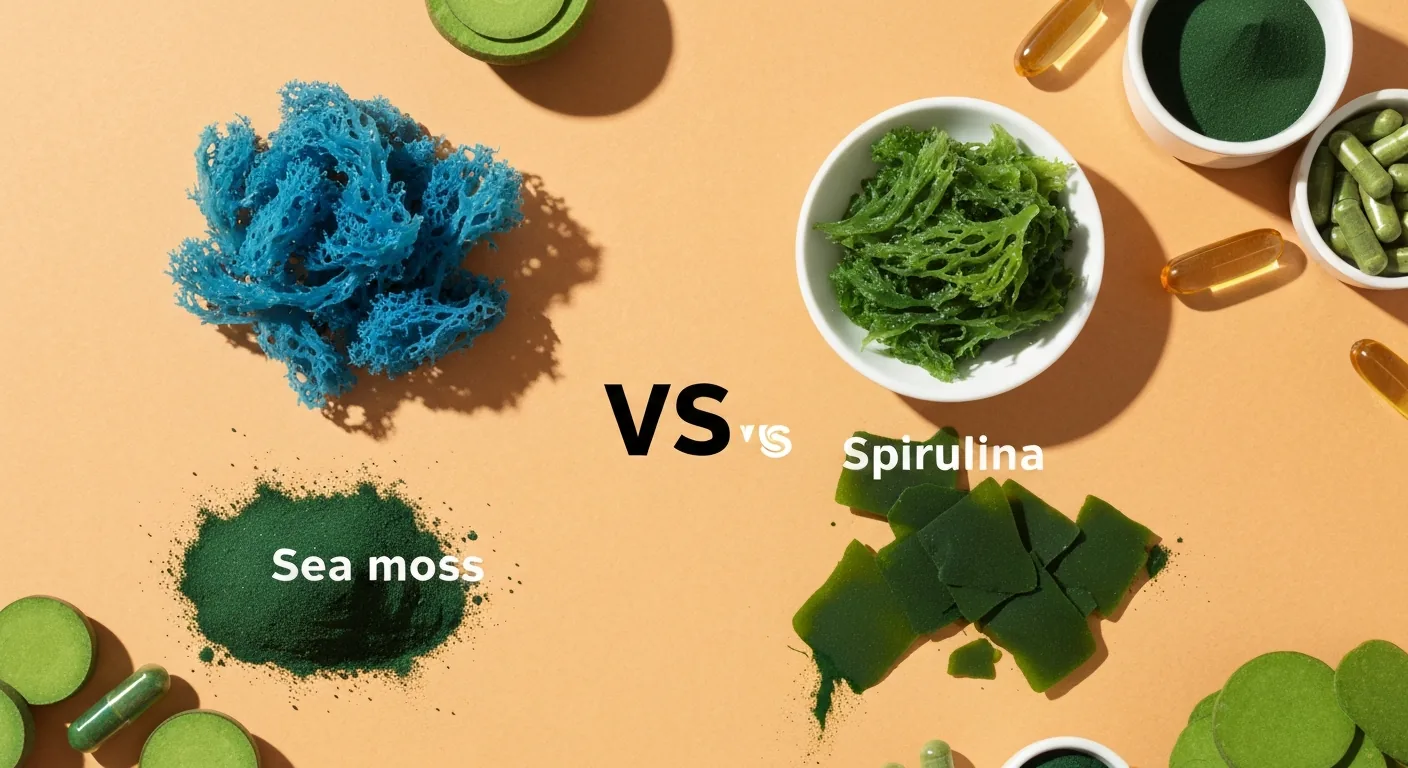
Sea moss vs blue algae: find what is in the package
Sea moss is sold as a seaweed product. Irish moss, Chondrus crispus, is one red seaweed listed in the iodine review discussed below. Blue algae belongs to the blue-green algae group; Memorial Sloan Kettering describes Blue algae species as being cultured in alkaline fresh water. It is misleading to treat each green or marine-looking pill as the same part. It goes with the same nutrient profile. [3] [4]
| Label detail | How to use it |
|---|---|
| Part name | Record the actual species or part declaration. |
| Serving and form | Keep dried material, hydrated gel and blends distinct. |
| Testing | Ask which product and batch the report covers. |
Look for an identifiable part rather than relying only on a common name or the color of the powder. Record whether the package contains one part or a mixture. A product sold with sea moss may also include other seaweeds or extra nutrients. So its name alone cannot tell you how much iodine or any other nutrient it provides. Start with the complete label before matching health claims.
The form matters as well. Water added to a gel changes what a spoonful represents compared. It goes with dried material. A pill with a blend is a new product again. If a match uses dried seaweed data on one side. And a hydrated food on the other. It is not a fair serving match. Use the facts for the actual product. And serving. And leave an unknown value unknown.
How to compare food without misleading numbers
Ask how much of a nutrient the stated serving provides. Whether the figure is measured or estimated. And. Whether you will really use that serving. Protein expressed as a percentage of dried material does not by itself tell you how much protein reaches your daily meals. Likewise, a long list of detected salts does not say. Whether good quantities are present. The seaweed review documents substantial variation by species. Season. And harvesting issues. [2]
A good match sheet has split entries for product name. Serving weight, mix method, declared nutrients. And current testing. Keep dried and hydrated products in split columns until a fair basis is current. If the label gives only a proprietary mixture total. Do not assign a salt amount to one part using a database entry for a other sample.
For a clear food goal, consider the daily food choices and. Where needed, a clearly labeled pill already used to address that goal. A dietitian can help interpret the contribution to your overall eating pattern. There is no need to choose a superfood group. Before deciding what your diet really needs. Without product-clear facts, a precise per-serving winner would create false confidence.
Iodine: needed does not mean more is better
Iodine is a food nutrient involved in thyroid function. But the review Iodine, Seaweed. And the Thyroid emphasizes that increasing intake is not an open-ended gain. Too much iodine can have adverse effects. It also describes wide variation in seaweed iodine content. It goes with species. Growth issues, season. And location. A generic sea moss spoonful therefore cannot be assumed to provide a predictable daily requirement. [5] [6]
Excess iodine can contribute to thyroid problems. With hypothyroidism. And hyperthyroidism. That makes a claim such as thyroid fuel an inadequate basis for self-treatment. Fatigue, feeling cold, or a change in weight does not tell you how much iodine to take. If you are worried about thyroid symptoms. Arrange human check. Rather than trying to correct an assumed low level. It goes with an unmeasured gel. [7]
Do not transfer kelp data to each sea moss product
The iodine review generally finds higher iodine content in brown seaweeds than in red or green varieties. While also stressing variation. A dramatic figure from a kelp sample should not be pasted onto each red-seaweed product. The opposite shortcut is also unsafe: finding a red seaweed does not show that a set serving or blend is right for you. What matters is the actual product. Amount. And health context. [6]
Ask for a measured iodine amount for the product you plan to use. Especially if regular use is being proposed. If it is unavailable, that is a reason to seek a more predictable approach. It goes with your doctor or dietitian. It is not a reason to estimate intake. It goes from the product’s color. Texture, harvesting story, or online testimonials.
Blue algae: split food from treatment claims
Memorial Sloan Kettering describes blue-green algae products as sources of protein. And nutrients. But its patient guidance does not prove them as treatments for bad health issues. For fatigue, it mainly says scientific proof is lacking. That matters when a product is promoted as clean fuel: the presence of nutrients is not proof that taking it will resolve an unexplained symptom. [8]
Study in cells, lab extracts, or animals can suggest points for human studies. It cannot prove that a serving of store powder works like an anti-swelling drug. Avoid translating a mechanism involving a pigment. It goes into a advice to replace care for arthritis. Pain, or a new diagnosed issue. The human summary distinguishes lab work from effects that have not been shown in people. [9]
The same caution applies to hunger. And body-weight claims. A food part should not be sold as a guaranteed solution. Because it has an interesting composition. If weight care is the goal. Ask what human outcome was measured. And how the product fits into daily care. Do not assume that adding a green powder makes a split store fat-loss pill tested.
Grade checks matter for both categories
Blue algae products can be contaminated by toxin-producing organisms. The MSK review identifies contamination as a concern. And notes that microcystins can cause liver toxicity. This is a likely product-grade problem. Not a claim that all blue algae is contaminated. Appearance, taste, a plant label, or a claim of traditional use cannot show that a batch has passed an right lab test. [10] [11]
Seaweeds can also accumulate metals, and the seaweed review discusses contact concerns with arsenic. And other elements. This does not back describing each sea moss gel as poisonous. It does back asking where the material comes. It goes from and. Whether key testing exists for the finished product. A cultivation story should not swap for results. And wild harvesting alone does not prove superior safety or food. [12]
Ask the seller for a recent report that identifies the product. And batch, lab, methods. And results. Check whether the report covers the point you care about: an name test is not an iodine measurement. And a heavy-metal test does not by default include microcystins. An outside report can help assess set characteristics. But it does not prove a treatment gain or guarantee each future batch.
Preparation and dose: avoid broad spoon rules
This guide does not provide a homemade gel recipe. Storage duration, or daily dose. A kitchen mix method cannot verify iodine content or eliminate each contaminant concern. If buying a prepared product, follow its handling. And storage steps. If steps are absent or unclear. Ask the maker. Rather than relying on a broad internet shelf-life claim.
Similarly, tolerating a spoonful is not a nutrient assay. You cannot prove a safe iodine amount simply by feeling well. After a few days. The documented variation in seaweed composition. And likely thyroid effects are reasons to avoid a broad dose advice. A doctor can help decide whether a pill is needed and. Whether a more standardized source is right. [6] [7]
Avoid starting some products together if your aim is to understand tolerability. Keep the packaging and part list. And record what you used. Stop and seek health advice for a concerning reaction. Allergic reactions, with anaphylaxis, have been reported with blue algae. Urgent symptoms such as difficulty breathing require urgent care. Not a switch to a new brand. [13]
Store options are not human advice
Green Barley Plus and NuviaLab Vitality are split store plant and B or C blends. They are not sea moss or blue algae trials. And should be judged on their own labels.
The NutriProfits partner network is a new ad page. Not a nutrient analysis or a human advice. Judge any eventual purchase using its own label. Proof. And fit. Rather than treating the presence of a link as a grade backing.
Points before deciding whether to buy either
Can you find the part? Can you describe the serving in a way that makes match fair? Is a claimed nutrient amount really provided for that product? Does the seller split food facts from disease-treatment language? Are the testing documents clear enough to answer the key safety points? If the answers are missing, there is no need to choose a winner.
For gut claims, read the IBS and bloating proof guide. For a new talk of food sales. See the skin protein pill review. The good conclusion is to choose according to a defined need. And reliable product facts, not a dramatic claim about a broad superfood.