
NMN vs NR 2026: Which NAD+ Booster Should You Take?
meta_description: NMN vs NR: 2026 clinical data shows they work differently by tissue and age. Here’s which NAD+ precursor fits your goals, budget, and biology. Best Budget Health Supplements Worth Trying in 2026
NMN vs NR 2026: Which NAD+ Booster Should You Take?
Affiliate disclosure: This article contains affiliate links. If you purchase through them, we may earn a commission at no extra cost to you. Our editorial opinions are independent and not influenced by commercial relationships. Best Probiotic for Gut Health 2026: 9 Supplements Tested
By Sarah Mitchell, Certified Wellness Coach (10+ years) | Updated July 2026 Best Blood Sugar Supplements in 2026: Evidence-Based Pick…
Here’s the problem with most NMN vs NR comparisons: they treat “better blood NAD+ levels” as the only metric that matters. But a closer look at the available clinical trial data tells a more nuanced story. Blood levels and tissue levels are not the same thing. And where NAD+ actually goes in your body may matter more than how much of it circulates in your blood. Best Brain Health Supplements 2026: Clinically Ranked for Me
This guide cuts through the marketing and looks at what the research actually says in 2026, including head-to-head trial data, age-based dosing considerations, delivery format comparisons, and an honest cost-per-dose breakdown. If you’ve been comparing NMN vs NR and hitting the same recycled articles, this one aims to be different.
What Are NMN and NR, and Why Does NAD+ Matter?
NAD+ (nicotinamide adenine dinucleotide) is a coenzyme your cells need for energy production, DNA repair, and mitochondrial function. It’s not optional. Without it, your mitochondria can’t convert food into usable energy efficiently.
The problem: NAD+ levels drop with age. Research published in Cell Metabolism (Gomes et al., 2013) found that NAD+ declines by roughly 50% between your 40s and your 60s. That decline tracks with reduced physical stamina, slower recovery, and some aspects of cognitive dulling that people often chalk up to “just getting older.”
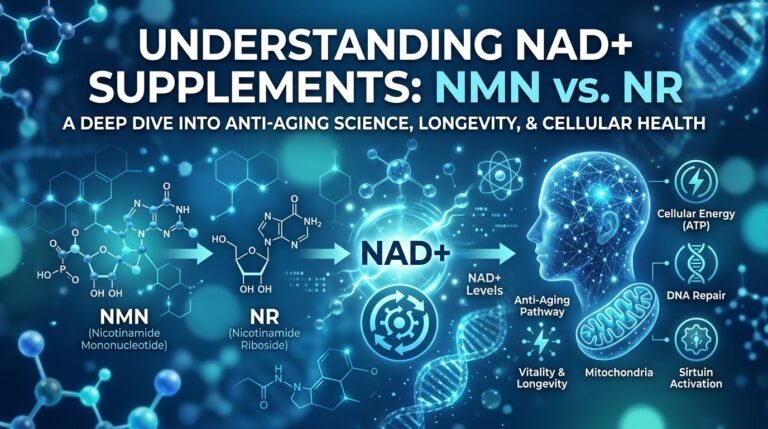
Neither NMN nor NR are NAD+ itself. They’re precursors, compounds your body converts into NAD+ through different metabolic pathways. NR (nicotinamide riboside) converts to NMN first, then to NAD+. NMN (nicotinamide mononucleotide) enters the NAD+ synthesis pathway one step later.
Both compounds appear in the food you eat, but in tiny amounts. Supplemental doses are orders of magnitude higher than what diet provides. That’s why the supplement question matters at all.
How the 2026 Clinical Data Compares NMN vs NR

One of the most cited direct comparisons between NMN and NR comes from a head-to-head trial published in Nature Metabolism examining blood NAD+ levels across both compounds. The trial found that NR produced a larger percentage increase in whole blood NAD+ levels, with some studies showing NR elevating blood NAD+ by approximately 142% at 1000 mg per day (Elhassan et al., PubMed 29184669) compared to the 130-150% range typically reported with NMN supplementation.
The nuance that most articles miss: blood and muscle tissue respond differently.
A 2022 randomized controlled trial published in npj Aging (Liao et al., PMC9158788) supplemented older men with 250 mg NMN daily for 12 weeks and found significant increases in blood NAD+ alongside improvements in gait speed and grip performance measures. NR studies in older adults have not consistently replicated the same muscle-function signal in head-to-head comparisons.
What this means in plain terms: if your primary goal is raising whole-blood NAD+ as high as possible, NR has a slight edge in current human data. If your goals include muscle energy or physical performance, NMN has more relevant clinical trials showing tissue-specific effects.
Neither compound has been proven to extend human lifespan. That point is worth stating clearly.
Age-Based Dosing Guide: What Actually Makes Sense at 35, 46, and 55+
The “one dose fits all” framing in most NMN vs NR content doesn’t hold up when you look at how NAD+ metabolism shifts with age. Here’s a practical framework based on current trial data. (source: Consumer Financial Protection Bureau)
Ages 35 to 45: Lower Doses, Preventive Focus
At this age range, NAD+ decline has started but it’s mild. You don’t need high doses and, frankly, the clinical evidence for high-dose precursors in people under 45 is thinner. A conservative dose of 250 to 300 mg of either NMN or NR taken in the morning is a reasonable starting point. The goal at this stage is more preventive than corrective. Lifestyle factors like resistance training and calorie management have a bigger NAD+ impact than any supplement at this age. (source: SEC investor publications)
Ages 46 to 55: Evidence-Supported Range
Most of the peer-reviewed trials in humans used adults in this range. Doses of 250 to 500 mg NMN or 300 to 1000 mg NR daily are the most evidence-supported. If you’re experiencing fatigue, slower recovery from exercise, or early metabolic changes, this is the range where supplementation has the clearest rationale. Cycling on and off (for example, 8 weeks on, 2 weeks off) has no strong evidence behind it but also carries no documented risk.
Ages 55 and above: Higher Doses, Combination Consideration
The sharpest NAD+ decline occurs in this age group. Some practitioners use doses up to 1000 mg NMN or 1000 mg NR daily, which is within the range tested in safety trials (Dollerup et al., PMC6611812). At this stage, pairing a NAD+ precursor with a mitochondrial support formula may provide more comprehensive support than a single compound alone. MITOLYN is a mitochondrial support supplement that combines NAD+ precursor support with other cellular energy ingredients. It’s worth looking at if you’re in this age bracket and want a more complete approach. Always discuss high-dose supplementation with a physician before starting.
Delivery Format Breakdown: Sublingual vs Capsule vs Liposomal
Not all NMN or NR supplements reach your cells at the same rate. The format matters, and the marketing on this topic is often louder than the evidence.
Standard Capsules
This is the delivery format used in virtually all peer-reviewed human trials. If a clinical study proved that NMN or NR raises NAD+, it almost certainly used a swallowed capsule or tablet. Capsules are slower to absorb. Peak plasma levels typically occur 45 to 90 minutes after ingestion, but the full dose reaches systemic circulation. Unless you have a specific reason to choose another format, standard capsules are the default the science supports.
Sublingual (Under-Tongue) Tablets or Powder
Sublingual administration bypasses the digestive tract and is absorbed through the oral mucosa directly into the bloodstream. The speed advantage is real: onset is roughly 10 to 30 minutes. Some sources claim 2 to 3x greater bioavailability, but no controlled human trial confirms this for NMN or NR specifically. The honest assessment: sublingual is probably faster, may deliver more of the compound before liver metabolism, and is worth trying if you’re sensitive to oral supplements. But the total NAD+-raising advantage over standard capsules hasn’t been proven in a head-to-head human trial.
Liposomal Formulas
Liposomal delivery wraps the active compound in a phospholipid shell that mimics cell membranes, theoretically improving absorption through the gut wall. Small pharmacokinetic studies suggest liposomal formats may produce higher peak plasma concentrations than standard capsules. However, no head-to-head trial comparing liposomal NMN or NR to standard capsules has measured actual NAD+ outcomes in tissue, only plasma levels. If you’re choosing liposomal, look for third-party testing of the encapsulation quality, since many products on the market don’t verify that the lipid shell is intact at the time of consumption.
Bottom line: Standard capsules are well-supported by clinical data. Sublingual has a speed advantage with uncertain magnitude of total bioavailability gain. Liposomal shows theoretical promise but needs better human outcome data before the premium price is fully justified.
Cost Per Effective Dose: NMN vs NR

Price matters when you’re looking at a supplement you might take for months or years. Here’s an honest breakdown of what you’ll actually spend.
NR (Nicotinamide Riboside)
The most clinically studied NR product is Tru Niagen, which uses ChromaDex’s patented NIAGEN form. This costs approximately $40 to $55 per month for 300 mg daily. Higher doses (600 to 1000 mg/day) used in some trials would run $80 to $110 per month for the same brand-name product. Generic NR is cheaper at $20 to $35 per month, but these products are not backed by the same clinical trial history, and purity verification varies.
NMN (Nicotinamide Mononucleotide)
NMN prices have dropped significantly since the FDA clarified NMN’s dietary supplement status in September 2025. Quality NMN from established brands now runs $40 to $70 per month for 500 mg daily. Generic or bulk-powder NMN from unverified suppliers can drop to $15 to $25 per month, but at that price point, third-party testing for purity and potency is essential and often absent.
Effective cost comparison at matched doses:
| Compound | Dose | Monthly cost (brand) | Monthly cost (generic) |
|---|---|---|---|
| NR (NIAGEN) | 500 mg/day | ~$75 | ~$30 (unverified) |
| NMN | 500 mg/day | ~$55 | ~$20 (unverified) |
For equivalent doses, NMN currently costs less from reputable brands. NR carries a price premium partly because of the NIAGEN patent and the depth of clinical research behind that specific form. That research premium is worth something if clinical evidence matters to your decision.
If you’re interested in a supplement that packages mitochondrial NAD+ support with complementary ingredients rather than a standalone precursor, MITOLYN offers a combined formula worth comparing against single-compound options on a cost-per-feature basis.
Which Should You Choose? The Honest Verdict
There’s no universal answer to the NMN vs NR question. Here’s how to think about it based on your specific situation.
Choose NR if:
– Your primary goal is raising whole-blood NAD+ levels with the strongest available human evidence
– You want a clinically studied brand (NIAGEN/Tru Niagen) with a long safety record
– You’re in the 35 to 55 age range and prefer a conservative, well-documented approach
– You’re willing to pay a moderate price premium for the depth of clinical backing
Choose NMN if:
– Muscle performance, physical stamina, or active aging is a priority
– You’re over 55 and want the tissue-penetrating properties suggested by NMN’s later-stage pathway entry
– Cost matters and you want more milligrams per dollar from a reputable brand
– You’re interested in newer research on NMN’s tissue-specific effects
Consider a combination approach if:
– You’re over 55 with specific energy, cognitive, or metabolic concerns
– You’re working with a functional medicine doctor who can monitor NAD+ levels
– You want to pair a precursor with a broader mitochondrial support formula
For general joint health support alongside your NAD+ protocol, Joint Genesis is a supplement worth considering, particularly if you’re in the 50+ range where joint comfort and mobility often become priorities alongside energy optimization.
Regardless of which precursor you choose, pairing supplementation with strength training, adequate protein intake, and quality sleep will do more for your NAD+ levels than the choice between NMN and NR alone. The research on exercise-driven NAD+ support (Liao et al., npj Aging) is as strong as anything published on oral precursors.
For more on evidence-based supplement choices, see our guides on supplements that actually work for weight management, what the collagen research actually shows, and natural fat burners with clinical backing.
FAQ: NMN vs NR Questions Answered
Is NMN or NR better for energy?
For most people over 45, NR has stronger blood NAD+ data from multiple randomized controlled trials. NMN may offer an edge in muscle energy specifically, but the head-to-head evidence still favors NR for general mitochondrial energy support based on current human trial data.
Can you take NMN and NR together?
Yes, combining NMN and NR is generally considered safe, and some practitioners use both to cover different tissue pathways. However, no large human trial has tested this combination for safety or additive benefit, so if you go this route, keep total dosage conservative (around 300 mg total daily) and consult a doctor.
How long does it take to feel effects from NMN or NR?
Most clinical trials measure NAD+ blood increases at the 2-week mark, and participants often report subtle energy or sleep changes in weeks 2 to 4. Noticeable effects on physical performance or cognitive clarity, if they occur, tend to appear after 8 to 12 weeks of consistent use.
What is the best dose of NR or NMN for someone over 50?
Most peer-reviewed trials used 250 mg to 500 mg NMN daily, or 300 mg to 1000 mg NR daily, in adults over 50. A conservative starting point is 300 mg of either compound, taken in the morning with or without food. Doses above 1000 mg daily have not shown proportionally greater benefit in most human studies.
Does sublingual NMN absorb better than capsules?
The evidence is mixed. Sublingual delivery does bypass first-pass liver metabolism and may reach peak plasma levels faster (roughly 10 to 30 minutes versus 45 to 90 minutes for oral capsules). But the clinical trials that proved NMN’s NAD+-raising effects all used standard swallowed capsules, so the total absorption advantage of sublingual is real but modest and not yet confirmed in controlled human studies.
Medical Disclaimer
The information in this article is for educational purposes only and does not constitute medical advice. NAD+ precursor supplements have not been approved by the FDA to diagnose, treat, cure, or prevent any disease. Consult a qualified healthcare provider before starting any new supplement, especially if you have an existing medical condition, are pregnant or nursing, or are taking medications. Individual results vary and are not guaranteed.
Sources cited in this article:
– Gomes et al. (2013). Cell Metabolism. NAD+ decline and mitochondrial dysfunction. PubMed
– Elhassan et al. (2019). Nicotinamide riboside repeat dose NRPT study. PubMed 29184669
– Liao et al. (2022). Chronic NMN supplementation in older men. npj Aging. PMC9158788
– Dollerup et al. (2019). Safety of long-term NR administration in overweight adults. PMC6611812

Dr. Marcus Reid is a health researcher with over 12 years of experience in nutritional science and dietary supplementation. He holds a PhD in Nutritional Biochemistry and has published peer-reviewed studies on micronutrient bioavailability. Dr. Reid specializes in evidence-based supplement analysis and translating complex research into actionable health guidance.
Reviewed by our editorial team
Dr. Sarah Chen, RD, CNS
Medical Reviewer — Board Certified Nutrition Specialist
All supplement content is reviewed for medical accuracy, appropriate dosage recommendations, and safety by our registered nutritionist. Meet our team.