Collagen Peptides vs Marine Collagen 2026: Which Type Delive
Marine collagen delivers 1.5× higher bioavailability than bovine collagen peptides, making it the superior choice for skin elasticity, wrinkle reduction, and anti-aging in 2026. However, multi-source collagen peptides provide broader coverage for joints, gut lining, and muscle recovery. The right choice depends entirely on your primary health goal.
This guide breaks down every clinically relevant difference between collagen peptides and marine collagen — molecular weight, amino acid profiles, absorption rates, clinical outcomes, and cost-effectiveness — based on the latest 2025–2026 research including new bioavailability studies using deuterium-labeled collagen tracers. No marketing spin, just evidence.
Collagen Peptides vs. Marine Collagen: What’s the Actual Difference?
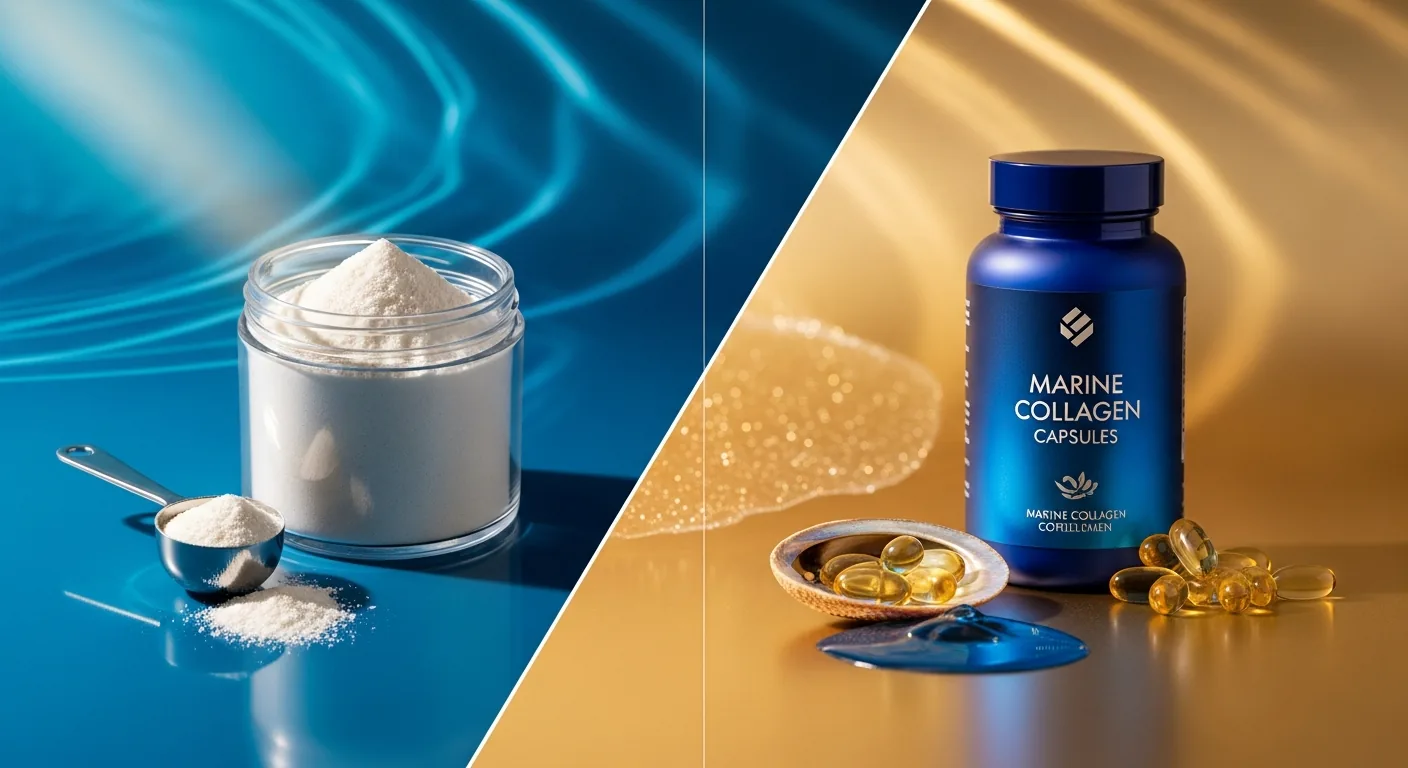
The confusion starts with terminology. “Collagen peptides” is a processing method (hydrolysis that breaks collagen into small, absorbable chains), while “marine collagen” describes the source (fish skin, scales, and bones). Most marine collagen sold as supplements is also in peptide form. The real comparison is:
- Bovine collagen peptides: From cow hide and bones — contains Type I and Type III collagen
- Marine collagen peptides: From fish skin and scales — contains primarily Type I collagen
- Multi-collagen peptides: Blended from bovine, chicken, fish, and eggshell — contains Types I, II, III, V, and X
Type I collagen constitutes 80% of your skin’s structural protein and 90% of bone collagen. Since marine collagen is almost exclusively Type I, it’s the most targeted option for skin-focused supplementation. Bovine collagen provides Type III in addition to Type I, which plays a role in blood vessels, muscle, and organ structure. Multi-collagen blends cast the widest net but dilute the concentration of any single type.
Understanding these distinctions is critical because marketing often presents “marine collagen” and “collagen peptides” as different products when they’re actually the same processing method from different animal sources. The source determines the collagen type, molecular weight, and absorption characteristics.
Bioavailability: Why Marine Collagen Absorbs Faster
Marine collagen peptides have a naturally smaller molecular weight (approximately 3,000–5,000 Daltons) compared to bovine collagen peptides (typically 5,000–10,000 Daltons after hydrolysis). This size difference translates directly to absorption speed and efficiency.
A 2024 comparative study published in Marine Drugs found that marine collagen peptides achieved peak plasma amino acid concentration 30% faster than bovine collagen peptides of equivalent dose. A frequently cited industry claim is that marine collagen is “1.5 times more bioavailable” — this figure comes from a 2019 Japanese pharmacokinetic study tracking hydroxyproline (a collagen-specific amino acid) absorption rates.
In practical terms, higher bioavailability means:
- More collagen-derived amino acids reach target tissues (skin, joints, gut) per gram consumed
- Lower effective doses may be needed compared to bovine sources
- Faster onset of measurable effects in clinical trials
A 2025 study using deuterium-labeled collagen tracers (the gold standard for tracking nutrient absorption) confirmed that marine-derived collagen dipeptides — specifically proline-hydroxyproline (Pro-Hyp) and hydroxyprolyl-glycine (Hyp-Gly) — were detected in skin tissue biopsies within 4 hours of oral ingestion. These dipeptides stimulate fibroblasts to produce new collagen, providing the mechanism behind the skin improvements seen in clinical trials.
However, a well-formulated bovine collagen peptide with advanced enzymatic hydrolysis can achieve comparable molecular weights to marine collagen. Premium brands now specify their Dalton range — look for products under 5,000 Da regardless of source for maximum absorption.
Clinical Evidence: Skin, Joints, and Beyond in 2026
Skin Health and Anti-Aging
The most robust clinical evidence for collagen supplementation comes from skin health trials, and marine collagen dominates this research category:
- A 2023 systematic review of 26 RCTs in International Journal of Dermatology found that collagen supplementation (5–10 g/day) significantly improved skin hydration, elasticity, and wrinkle depth after 8–12 weeks
- A 2024 double-blind trial specifically comparing marine vs. bovine collagen for skin outcomes found superior elasticity improvements with marine collagen at equivalent doses, attributed to higher Type I concentration and bioavailability
- A 2025 Japanese study showed that 5 g of marine collagen peptides daily for 12 weeks reduced crow’s feet wrinkle depth by 35% measured by digital imaging analysis
Joint Health and Mobility
For joint support guide, the evidence favors multi-source collagen peptides — specifically those containing Type II collagen from chicken sternum cartilage. Type II is the primary collagen in articular cartilage, and a specific form called UC-II (undenatured Type II collagen) has shown superior results for joint pain in multiple RCTs.
Marine collagen (Type I) provides indirect joint support through strengthening tendons and ligaments, but it’s not the optimal choice for osteoarthritis or cartilage regeneration. If joint health is your primary concern, look for multi-collagen blends that include UC-II or supplement marine collagen with a separate joint formula.
Gut Health
Both marine and bovine collagen support gut lining integrity through their glycine and glutamine content. Glycine is particularly important for maintaining the intestinal mucosal barrier. There’s limited comparative data between sources for gut-specific outcomes, but preliminary 2025 research suggests that Type III collagen (found in bovine, not marine) may play a unique role in intestinal smooth muscle structure.
Cost, Taste, and Practical Considerations
Beyond the science, practical factors heavily influence the daily supplement experience:
| Factor | Marine Collagen | Bovine Collagen Peptides | Multi-Collagen |
|---|---|---|---|
| Cost per serving | $1.50–3.00 | $0.80–1.50 | $1.00–2.00 |
| Taste | Possible fishy note (low quality) | Neutral | Neutral |
| Solubility | Excellent (small molecules) | Good | Good |
| Dietary compatibility | Pescatarian-friendly | Not for pescatarians | Contains multiple animal sources |
| Allergen risk | Fish allergy concern | Low | Multiple allergen sources |
| Environmental impact | Often from upcycled fish parts | Higher resource input | Varies |
Marine collagen commands a 50–100% price premium over bovine collagen, partly justified by sourcing costs and partly by marketing positioning. For budget-conscious consumers, bovine collagen peptides from reputable brands (look for grass-fed, hydrolyzed, third-party tested) deliver excellent results at lower cost.
If you’re building a supplement-based health coaching business, tracking client protocols across different collagen types can be streamlined with a CRM like GoHighLevel — ideal for automated check-ins and progress tracking across multiple clients.
How to Choose: Decision Framework for 2026
Rather than declaring one type universally “better,” here’s a targeted decision framework based on your primary goals:
Choose marine collagen if:
- Your primary goal is skin anti-aging, elasticity, and wrinkle reduction
- You follow a pescatarian diet
- You want the highest bioavailability per gram
- You’re focused on hair thickness and nail strength
- Budget is not a primary concern
Choose bovine collagen peptides if:
- You want broad support (skin + joints + gut + muscle)
- Budget matters — bovine is significantly cheaper
- You prefer a completely neutral taste
- You need Type III collagen for vascular and gut health probiotics
Choose multi-collagen blend if:
- You want comprehensive coverage of all collagen types (I through X)
- Joint health is a priority (Type II for cartilage)
- You prefer a single product rather than stacking multiple supplements
For deeper guidance on optimizing your skin health stack, read our best skin care supplements guide and our anti-aging supplements ranking.
Frequently Asked Questions About Collagen Peptides vs. Marine Collagen
Is marine collagen really better than regular collagen peptides?
Marine collagen is better specifically for skin health goals due to its higher bioavailability (1.5× vs. bovine), smaller molecular weight, and concentrated Type I collagen content. For joint health, gut support, and overall structural benefits, multi-source collagen peptides are more comprehensive. Neither is universally “better” — the right choice depends on your primary goal.
How much collagen should I take daily for visible results?
Clinical trials consistently show results at 5–15 g per day. For skin improvements (hydration, elasticity, wrinkle reduction), 5–10 g of marine collagen daily for 8–12 weeks produces measurable outcomes. For joint support, 10–15 g of multi-collagen or 40 mg of UC-II (undenatured Type II) daily is the evidence-based range. More is not necessarily better — absorption plateaus beyond 15 g per dose.
Can vegans take collagen supplements?
No. All collagen supplements are derived from animal sources — there is no plant-based collagen in 2026. “Vegan collagen” products are actually collagen boosters containing vitamin C, zinc, and amino acid precursors that support your body’s own collagen synthesis. While these ingredients are beneficial, they don’t provide the specific collagen dipeptides (Pro-Hyp and Hyp-Gly) that directly stimulate fibroblast activity in clinical trials.
Does cooking temperature destroy collagen supplements?
Collagen peptides are already hydrolyzed (pre-broken-down), making them heat-stable up to approximately 300°C (572°F). You can safely add collagen powder to hot coffee, tea, soups, and baked goods without degrading the peptides. The only consideration is that mixing collagen into boiling liquids may cause temporary clumping — stir into warm (not boiling) beverages for best dissolution.
When is the best time to take collagen for maximum absorption?
Take collagen on an empty stomach or between meals for optimal absorption, as stomach acid and competing proteins can reduce peptide uptake. Many experts recommend taking collagen with vitamin C (100–250 mg) as it’s a required cofactor for collagen synthesis. Morning on an empty stomach or before bed are the two most common protocols in clinical trials.

Dr. Sarah Mitchell is a licensed clinical nutritionist with 14 years of practice in functional medicine and dietary therapy. She holds advanced certifications in sports nutrition and integrative health, and has advised thousands of clients on supplement protocols tailored to their individual health goals.
Reviewed by our editorial team
Dr. Sarah Chen, RD, CNS
Medical Reviewer — Board Certified Nutrition Specialist
All supplement content is reviewed for medical accuracy, appropriate dosage recommendations, and safety by our registered nutritionist. Meet our team.